Beckett Cocke, Jack Drygas, Graham Anand and Gaston Gramatica among players pushing the limit of the position at the prep level.
In the NFL, the 60-yard field goal used to be a rarity — something attempted only in halftime-ending desperation. Today, 60-yard attempts no longer shock fans. Many are made. Boots that once belonged only to legends have become just another weapon in a team's weekly arsenal.
In 2025, NFL kickers have broke a record with seven field goals of 60 yards or more, smashing the previous record of five in 2022 and 2023. Cam Little of the Jacksonville Jaguars broke the NFL record with a boot of 68 yards.
According to Jamie Kohl of Kohl's Kicking, there is good reason for this explosion in distance.
"We at Kohl's have been fortunate to work with the majority of the guys kicking those 60-yarders in games and have seen them continue to get better over the years," Kohl said. "Out of the 96 starters in the NFL (32 kickers, 32 punters, 32 snappers) 75 have attended our camps."
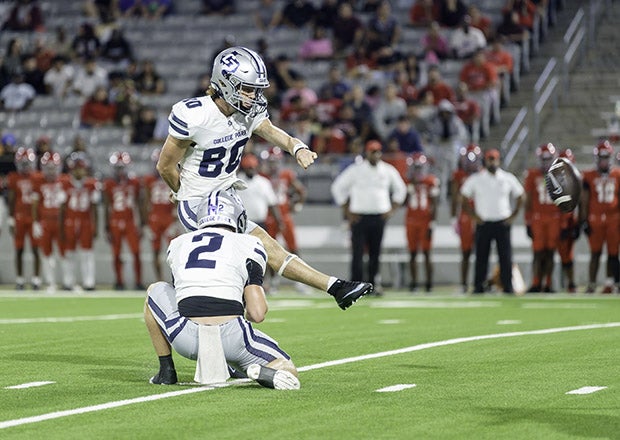
Beckett Cocke hit field goals of 40 yards or longer in five games this season and went 19 of 21 overall, giving the College Park offense an extra dimension. (PHOTO: Dustin Nguyen)
The modern NFL kicker, Kohl says, is a different type of athlete — stronger, more technical and trained with precision.
"The type of athletes, improved training techniques and more overall competition has led to these types of performances along with a better ball to kick in games," Kohl said.
That "better ball" is no small factor. The league's famous K-ball, long notorious for being slick, hard and difficult to strike, is now thoroughly broken in under new NFL rules.
"The broken-in K ball has helped these performances take place in games," Kohl said. "The ball flies further when it's broken in and now they are totally broken in with the new NFL rules."
Kohl has used the Wilson Duke for 25 years, calling it the gold standard — the same ball NFL kickers use. But he is quick to point out that it takes time to soften the leather so it compresses fully off the foot.
That is part of why high schoolers are also kicking the ball farther than ever. Many have begun using options like the KS1, which Kohl describes as "a ball that compresses a little easier out of the box than the Wilson Duke and is a cheaper option for high school players."
"I do expect high school players to continue to get better and kick longer field goals than previous years. It's a combination of a lot of items," Kohl said.
The McPherson Effect
While NFL distances climb each year, the ripple effect can be felt throughout high school football — nowhere more than at
Fort Payne (Ala.). There, head coach Chris Elmore has watched generations of kickers push the school's limits.
"We don't have a special ball per se," Elmore said. "But every one of our kickers have always had two or three footballs that they really liked and they would only use them for practice and games. They like for them to have a lot of air in them."
Kicking has long been part of Fort Payne's identity. Elmore traces the lineage back decades. Matt Hammond, Bryan Northcutt and David Stanley all added a chapter. Northcutt, the first soccer-style kicker at Fort Payne, hit a 50-yarder in 1989-90, which Elmore notes was notable at that time.
But then came the family that changed everything: the McPhersons.
Logan arrived with a soccer background and left with a 57-yard school record. His younger brother Evan kicked on varsity as an eighth grader, broke the Alabama state record with a 60-yard field goal in 2017 — and his brother Alex held the ball.
Evan now plays in the NFL for the Cincinnati Bengals. Just two weeks ago, McPherson broke the Cincinnati team record with a 63-yard field goal against the New England Patriots.
Alex followed by breaking Evan's Fort Payne record with a 61-yarder. He then made four field goals of 50-plus yards in the same game, another state record.
Currently playing at Auburn, Alex recently won the Courage Award given by the Football Writers Association of America after making 20 of 23 field goal attempts this year — less than one year after having surgery to remove his large intestine due to a bout of ulcerative colitis.
Elmore calls what followed the "McPherson effect." Younger athletes — Conner Hughes and Hayden Chambers — watched the family's success and followed the same year-round training habits. Soon, both were hitting from the high 50s, breaking school records and pushing the limits of what was once thought impossible for high school legs.
"It is a year-long preparation that they do (kind of like playing golf) where they are constantly working on their craft," Elmore said. "Work ethic is what made the McPherson brothers special… I have seen Alex train on a cold January day when he had nothing to look forward to but a game that was eight months away."
And just as in the NFL, science and technology now play major roles.
"Kicking has evolved so dramatically over the past 10 or so years," Elmore said. "The mechanics and science… are being studied more closely than ever before, with new technology like the Trackman… Coaches are also becoming more knowledgeable… adjusting the slightest flukes in a swing."
On the question of just how far this progression can go, Elmore offers a realistic but optimistic view:
"I think at some point the distance will max out for kickers but I do think you will see more and more 60 plus over the coming years."
He has seen it with his own eyes — Alex once made a 70-yarder in warm-ups and came about four yards short on a 70-yard attempt in a game.
The movement's front line
In Texas, one of the nation's deepest pools of football talent,
Beckett Cocke of
College Park (The Woodlands, Texas) is living this kicking revolution firsthand.
"I have hit a few 60 yarders in practice," Cocke said.
He hasn't yet attempted one in a game, but his warmups routinely reach the mid-50s.
Cocke leads the nation with 20 field goals along with 75 extra points for a high of 135 kicking points. Cocke trains with a precision that mirrors what Kohl and Elmore describe.
"My training during the season consists of focusing on specific parts of my kicking each day," Cocke said. "The biggest thing I have to make sure of is to not over kick… that often leads to injury and forming bad habits."
Cocke attended a Kohl's Kicking camp, where he says the coaches "were very knowledgeable" and helped with field goal and kickoff evaluation along with detailed mechanics work.
With a powerful offense giving him more attempts, Cocke has already hit 47-yarders in games and continues to push outward. He sees what's happening at the college level, too.
"As kicking is evolving, colleges are definitely expecting more out of kickers as the bar is being raised… Field goals from 60 are getting more and more common."
Like many top high school specialists, his dream is to compete at the next level:
"I hope to play at the collegiate level one day… and if an opportunity (in the NFL) was presented to me, I would 100 percent take advantage of it."
Where the future Is aiming
From the NFL's broken-in K-ball to Alabama's McPherson effect to Texas prospects booming 60-yarders in practice, one truth echoes through every level of the sport: field goal kicking is changing faster than ever before.
This year at the high school level,
Jack Drygas of
Legacy Christian Academy (Frisco, Texas) hit a 64-yard field goal.
Greater Atlanta Christian (Norcross, Ga.) kicker
Graham Anand booted a 60-yarder three weeks ago.
Then there is
Gaston Gramatica of
Cambridge Christian (Tampa, Fla.), son of former NFL kicker Martin Gramatica, who kicked a 62-yard field goal this year. The distance is farther than his father had kicked at the prep or pro level, although dad did have a 65-yard field goal while at Kansas State.
Such feats aren't just outliers either, they are part of a rapidly expanding range of what young kickers are proving possible.
If the trend continues, those 60-yard NFL bombs may soon look ordinary — because somewhere, perhaps on a high school field in Texas or Alabama, a teenager is already hitting from 65.
