MaxPreps preseason No. 1
St. John Bosco (Bellflower, Calif.) lost its season opener to
Bishop Gorman (Las Vegas, Nev.). One week later, Bishop Gorman took over the top spot only to fall to
Columbus (Miami, Fla.).
History suggests neither team should be counted out.
Unlike college football, where a single loss once carried the weight of an entire season, high school football’s national championship picture has rarely been that simple. Strength of schedule, state championships, playoff rematches and head-to-head results often matter more than an unblemished record.
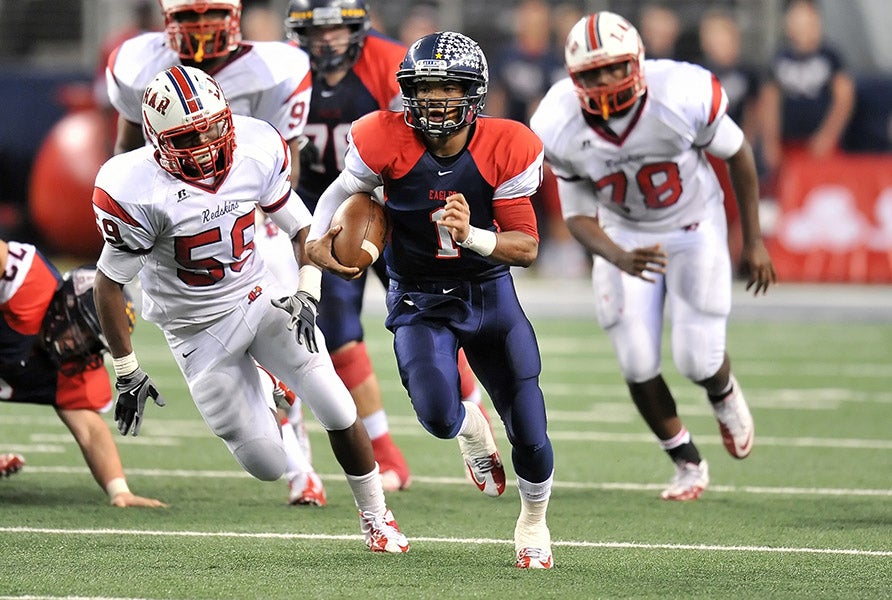
Kyler Murray ran for 143 yards and two touchdowns to lead Allen to a victory in the 2012 Class 5A Division 1 state championship game in Texas. The Eagles would go on to be recognized as the national champions by multiple media outlets that season despite a loss on their record. (PHOTO: Kyle Dantzler)
In fact, dozens of teams have finished with a loss or tie and still claimed a national championship. St. John Bosco knows that better than most. The Braves lost during the regular season before finishing No. 1 in 2019 and again in 2022.
The concept of a high school football national champion dates to the early part of the 20th century when leading teams from all over the country occasionally met in games billed as title contests. More than one such game was sometimes played in the same year, resulting in multiple schools claiming the crown.
The first annual national rankings arrived in 1959 through Art Johlfs, a Minnesota real estate agent and high school sports enthusiast. Operating the one-man National Sports News Service, Johlfs ranked as many as 135 teams at the end of each season and retroactively selected national champions dating to 1927.
When Barry Sollenberger of Arizona assumed control of the NSNS following Johlfs’ retirement in the late 1970s, he extended those selections back to 1910.
USA Today brought it into the modern era in the early 1980s when Dave Krider began producing weekly rankings. MaxPreps, Blue Star Media, Sports Illustrated, ESPN and High School Football America were among the outlets that later joined the landscape.
The following teams overcame at least one loss or tie to finish as national champions, whether through a national championship game, a retroactive NSNS selection or a No. 1 ranking from a national media outlet.
1910 – Oak Park, now Oak Park-River Forest (Ill.)
Record: 10-2
Losses: Maywood Young Men's Club 6-2, Morgan Park Academy 9-6
Ranked No. 1 by: National Sports News Service (NSNS), Barry Sollenberger
Why it was still No. 1: Chicago had established itself as an early center of high school football, highlighted by Hyde Park’s 105-0 victory over Brooklyn Prep in a 1902 national championship game. Coached by future Illinois legend Robert Zuppke, Oak Park shut out nine opponents and outscored its Chicago high school competition 179-0. The Huskies also traveled west to defeat
Wenatchee (Wash.) and Washington (Portland, Ore.), the latter in a national championship game. Both losses came against non-high school opponents.
1913 – Oak Park (Ill.)
Record: 10-1
Loss: Oak Park Alumni 10-0
Ranked No. 1 by: NSNS, Sollenberger
Why it was still No. 1: After winning national championships from 1910 through 1912, Oak Park opened the 1913 season against a formidable collection of former players. The alumni handed the Huskies their only loss but Oak Park averaged 50 points over the remainder of the season and defeated
Scott (Toledo, Ohio) 32-7 in a national championship game.
1915 – Central (Detroit, Mich.)
Record: 11-0-1
Tie: Everett (Mass.) 0-0
Ranked No. 1 by: NSNS, Sollenberger
Why it was still No. 1: Detroit Central and Everett met on a muddy field in a national championship game that ended without a score. Central narrowly missed a 37-yard field goal in the closing moments. Its résumé also included victories over Ohio powers
Waite (Toledo) and Scott, Michigan stalwart
Muskegon and four-time national champion Oak Park.
1915 – Everett (Mass.)
Record: 11-0-1
Tie: Detroit Central 0-0
Ranked No. 1 by: NSNS, Sollenberger
Why it was still No. 1: A year after finishing 13-0 and outscoring opponents 600-0, Everett opened with seven more shutouts. Its scoreless tie against Detroit Central marked the program’s 24th shutout in two seasons and resulted in the teams sharing the national championship.
Record: 12-0-1
Tie: Aberdeen 0-0
Ranked No. 1 by: High School Sports History
Why it was still No. 1: Everett overwhelmed a schedule that included high schools and military teams, outscoring opponents 544-19. The lone blemish came when Aberdeen held Everett scoreless in a game played in pouring rain.
1919 – Scott (Toledo, Ohio)
Record: 8-0-1
Tie: Everett (Wash.) 7-7
Ranked No. 1 by: National championship game
Why it was still No. 1: Scott defeated several of the Midwest’s top programs, including
Washington (Massillon, Ohio), Detroit Central,
Shaw (East Cleveland, Ohio) and Waite. The Bulldogs then traveled approximately 2,300 miles to face Everett in a national championship game. The tie led both schools to claim a share of the title, although the NSNS selected undefeated Harrisburg Tech (Pa.) as its national champion.
1919 – Everett (Wash.)
Record: 8-0-2
Ties: University of Washington 7-7, Toledo Scott 7-7
Ranked No. 1 by: National championship game
Why it was still No. 1: Everett regularly tested itself against college competition during the 1910s. One of its two ties came against the University of Washington and the other against Toledo Scott in the national championship game.
1920 – Everett (Wash.)
Record: 11-0-1
Tied: Everett Alumni 13-13
Ranked No. 1 by: National championship game
Why it was still No. 1: Everett’s greatest challenge came from its own former players, who tied the team in the season opener. Everett later defeated the Bremerton Navy Yard, Naval Base Hospital, University of Washington and
Long Beach Poly (Long Beach, Calif.) by a combined score of 159-0 before beating Cleveland East Tech 16-7 in a national championship game.
1920 – Oak Park
Record: 9-0-1
Tie: New Trier 3-3
Ranked No. 1 by: NSNS, Sollenberger
Why it was still No. 1: Multiple contests were sometimes promoted as national championship games during the early 20th century. Oak Park claimed such a victory over Dayton Steele while Everett won another national championship matchup. The NSNS ultimately selected Oak Park despite its tie with New Trier.
1923 – Shaw (East Cleveland, Ohio)
Record: 9-1
Loss: Elyria via forfeit
Ranked No. 1 by: NSNS, Sollenberger
Why it was still No. 1: Shaw’s only loss resulted from a disputed officiating decision. Trailing Elyria 3-0 in the third quarter, Shaw left the field and was charged with a forfeit. It recovered to defeat
Salem (Mass.) 26-0 in a national championship game.
1947 – Lynn Classical (Lynn, Mass.)
Record: 11-1
Loss: Peabody 12-7
Ranked No. 1 by: NSNS, Art Johlfs
Why it was still No. 1: Led by All-American and gifted all-around athlete Harry Agganis, Lynn Classical lost an early-season game played in the rain after committing multiple fumbles. The Rams dominated the rest of the way, including a postseason victory over an undefeated Nashua (N.H.) team in a matchup between two of New England’s best.
1960 – Miami (Fla.)
Record: 8-0-1
Tie: Lakeland 27-27
Ranked No. 1 by: NSNS, Johlfs
Why it was still No. 1: Johlfs initially ranked Miami Senior No. 1 despite its tie because second-ranked Chicago Mt. Carmel had a loss. Later versions of Johlfs’ championship list published in Doug Huff’s National High School Record Book named undefeated
Lawrence (Kan.) as the 1960 champion. Lawrence, however, appeared at No. 12 in Johlfs’ original rankings.
1962 – Miami
Record: 8-1
Loss: Miami Jackson 13-6
Ranked No. 1 by: Imperial Sports Syndicate
Why it was still No. 1: The Stingarees rarely lost to rival
Jackson (Miami) but their lone defeat came against the Generals. The short-lived Imperial Sports Syndicate nevertheless named Miami and
St. Ignatius College Preparatory (San Francisco, Calif.) co-national champions. Neither appeared in Johlfs’ final top 15.
1968 – Coral Gables (Fla.)
Record: 12-1
Loss: Killian 19-13
Ranked No. 1 by: NSNS, Johlfs
Why it was still No. 1: After sharing the 1967 national championship with Reagan (Austin, Texas), Coral Gables repeated the feat despite losing to
Killian (Miami). Reagan finished 15-0 but Johlfs often kept defending national champions near the top of his rankings as long as they continued winning state titles.
1969 – Valdosta (Ga.)
Record: 12-0-1
Tie: Clarke Central 26-26
Ranked No. 1 by: NSNS, Johlfs
Why it was still No. 1: Valdosta tied Clarke Central in the state championship game and shared the Georgia title. Johlfs maintained that the Wildcats were better than the 1968 team that finished No. 2 nationally and named them co-national champions with Coral Gables. The Cavaliers went undefeated but did not participate in Florida's state playoffs.
1970 – Reagan (Austin), now Northeast Early College
Record: 14-1
Loss: Spring Branch 13-10
Ranked No. 1 by: NSNS, Johlfs
Why it was still No. 1: Reagan won its third state championship in four seasons in Texas’ largest classification after finishing No. 1 nationally in 1967 and 1968. Johlfs placed the Raiders ahead of undefeated Massillon Washington and a
Bishop Amat (La Puente, Calif.) team led by future USC quarterback Pat Haden.
Record: 12-1
Loss: Dougherty 27-20
Ranked No. 1 by: NSNS, Johlfs
Why it was still No. 1: Thomasville entered the season as the defending Class AAA state champion and captured another title despite a midseason loss. Four of the top five teams in Johlfs' final rankings had one defeat, allowing the two-time state champion Bulldogs to retain the No. 1 position.
Record: 15-1
Loss: Coppell 27-24 (OT)
Ranked No. 1 by: CalPreps, Massey Ratings, High School Football America (HSFA)
Why it was still No. 1: Allen lost only once during Kyler Murray's three varsity seasons and it came when the sophomore did not start against Coppell. Murray took over the starting job and led the Eagles through the postseason, winning all six playoff games by at least two touchdowns.
Record: 13-2
Losses: Bishop Amat via forfeit, St. John Bosco 41-18
Ranked No. 1 by: Blue Star Media, CalPreps, USA Today, HSFA, Prep Force
Why it was still No. 1: Mater Dei finished 14-1 on the field but forfeited its season-opening win over Bishop Amat. After losing to St. John Bosco during Trinity League play, the Monarchs defeated
Mission Viejo,
Centennial (Corona), St. John Bosco and
De La Salle (Concord) in the postseason to reclaim the No. 1 ranking.
2019 – St. John Bosco
Record: 13-1
Loss: Mater Dei 38-24
Ranked No. 1 by: Max Preps, Blue Star Media, HSFA, USA Today, Prep Nation, Prep Force
Why it was still No. 1: St. John Bosco lost to Mater Dei in league play but earned a second chance in the Southern Section Division 1 championship game. The Braves avenged the loss and added playoff victories over Centennial and De La Salle to finish No. 1 nationally.
2022 – St. John Bosco
Record: 13-1
Loss: Mater Dei 17-7
Ranked No. 1 by: MaxPreps, Blue Star Media, CalPreps, HSFA, Massey Ratings, USA Today, Scorebook Live
Why it was still No. 1: Mater Dei was talented enough to finish No. 3 in the final MaxPreps Top 25, making St. John Bosco's playoff rematch especially significant. The Braves defeated the Monarchs in the Southern Section championship game and climbed to No. 1.
2023 – Mater Dei (Calif.)
Record: 13-1
Loss: St. John Bosco 28-0
Ranked No. 1 by: Scorebook Live, Blue Star Media, CalPreps, HSFA
Why it was still No. 1: For the fourth time in six seasons, the loser of the regular-season showdown between Mater Dei and St. John Bosco rebounded to win the Southern Section championship. The Monarchs avenged their loss, captured a state championship and finished No. 1 in multiple national rankings.
2025 – St. Thomas Aquinas (Fort Lauderdale, Fla.)
Record: 14-1
Loss: Mater Dei 26-23
Ranked No. 1 by: HSFA
Why it was still No. 1: St. Thomas Aquinas lost to Mater Dei in its season opener but did not lose again. With
Santa Margarita (Rancho Santa Margarita, Calif.) emerging as Southern California's champion and both Mater Dei and St. John Bosco falling out of contention, the Raiders steadily climbed to No. 1 in the High School Football America rankings.
That history should offer encouragement to St. John Bosco and Bishop Gorman. A loss complicates the path to a national championship but it does not close it. With difficult schedules and opportunities to defeat other nationally-ranked opponents, both still have time to assemble a championship résumé.
