MaxPreps has compiled a list of the 100 most influential people in the history of high school football. The list continues with Nos. 51-75 and includes familiar names like Vince Lombardi, Jim Brown and Bo Jackson along with others who shaped the sport over the past 150 years.
In order to gain an understanding of the people who have influenced high school football, MaxPreps contacted sports historians from across the country for their input. They included the following: Van Williams (Alaska), Stu Pospisil (Nebraska), Doug Nareau (California), John Moriello (New York), Kev Varney and Tom Sikorski (Illinois), Patrick Schmiedt (Wyoming), Kevin Patrowsky (Wisconsin), Mark Tennis (California), Todd Holcomb (Georgia), Seth Polansky (Arizona), Gerry Valerio (Colorado), Joe Lee Smith (Texas), Ron Siegel (Washington), Ron Pesch (Michigan), Tim Hudak (Ohio) and Loren Maxwell (Georgia).
After consulting with the experts and further research of the history of the sport, MaxPreps compiled a list to give a wide-ranging look at the people who influenced the sport. We not only included the coaches and the players, but also journalists, administrators, inventors and innovators.
The list continues with arguably the greatest running back in NFL history.
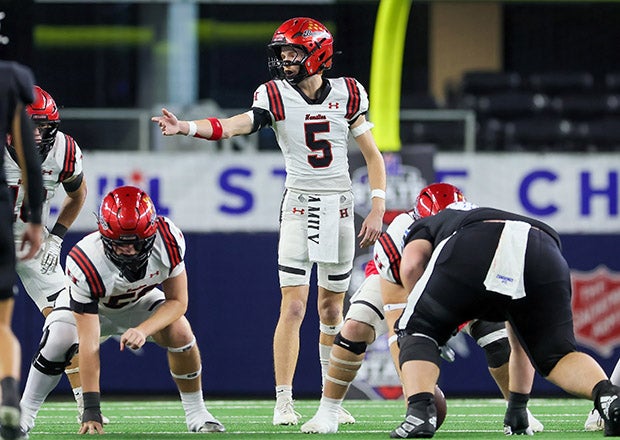
Thanks to former San Francisco 49ers coach Red Hickey, the shotgun formation has opened up a world of possibilities for offenses. (PHOTO: Robbie Rakestraw)
75. Jim Brown
Hall of Fame running back
An outstanding all-around athlete in high school at
Manhasset (N.Y.) and college, Brown was an example of dedication, intensity and strength as a player at the professional level. He refused to show his opponents when he was injured and rarely complained to officials, showing a high level of mental toughness.
74. Red Hickey
Created shotgun formation
The coach of the San Francisco 49ers in the 1960s, Hickey utilized the shotgun formation out of necessity. His offensive line wasn't very good so he set up his quarterback a good distance behind the line to give him time to throw. The formation went out of fashion and was used on occasion by the Dallas Cowboys under Tom Landry. However, it has become increasingly popular at all levels of play during the 21st century.
73. Vince Lombardi
Hall of Fame coach
During his time at St. Cecilia in New Jersey, Lombardi developed one of the top teams in the nation by emphasizing perfect execution of basic plays rather than complex systems. He took this philosophy to the NFL where his Green Bay Packers won five NFL championships.
72. Midwest Oil Refinery
Lights for first night game
The first "Friday Night Lights" took place in Wyoming thanks to the football fans at the Midwest Oil refinery. Employees of the refinery were unable to watch the Midwest (Wyo.) football games during the day they were working. School and refinery officials got together to install electric lights on the field in 1925 to allow the employees to attend the games at night.
71. Bo Jackson
Two-sport athlete, NFL and MLB
A product of
McAdory (McCalla, Ala.), Jackson became the first professional athlete in the modern era to play football and baseball in the same year, competing for the Los Angeles Raiders and the Kansas City Royals. His success in both sports showcased that elite athleticism could be utilized in multiple sports.
70. Frank Dickinson
Developed rankings system for playoffs
Sometimes known as "computer" rankings, formula football rankings have been around for nearly 100 years. The longest-running ranking system is the Dunkel Index, devised by Richard Dunkel in 1929. However, the first widely-regarded football ranking system began in 1926 when Dickinson, a University of Illinois economics professor, developed his formula. The NCAA used the formula to award the Rissman Trophy to recognized college football's best team. Dickinson continued to produce his formula rankings until 1940 when he left Illinois to conduct research in medicine and economics, according to an article on the Illinois Liberal Arts & Sciences website. The Dickinson formula was used to rank college football teams, but later formula football rankings were used to rank high school teams, including the Dunkel Index in the 1950s (in Florida) and the Litkenhous Ratings in the 1930s.
69. Tom Lemming
Recruiting guru
Before there was Rivals, 247Sports, Scout or SuperPrep there was Lemming. A former high school sports reporter, Lemming began scouting football prospects in 1979. Known for driving thousands of miles every season to see the prospects in person, Lemming also spent many hours reviewing film of players before coming out with his Prep Football Report magazine. Even 40 years later, Lemming is still scouting high school football players as part of his website. In the past, he has provided content to ESPN, USA Today, MaxPreps and CBS Sports.
68. Dennis Deninger
Scholastic Sports America
A coordinating producer for SportsCenter on ESPN, Deninger originated Scholastic Sports America — a show dedicated to high school sports — in 1986. The only show of its kind on national television, it ran until 2001. Chris Fowler of ESPN's College GameDay was the original host of the show. Deninger worked for 25 years at ESPN, has gone on to write several books about sports and is currently a professor at Syracuse.
67. Neil Kerr
Longtime New York journalist
For 45 years, Kerr compiled a weekly newsletter for the New York State Sports Writers Association, compiling rankings, scores, standings and all-state teams. He also wrote for the Syracuse Post Standard and lobbied hard for the NYSPHSAA to conduct high school football playoffs, which they did in 1993.
66. Nancy Skinner
Wrote "Pay for Play" bill in California
As a congresswoman in California, Skinner promoted the "Pay for Play Act" that led to college athletes being able to receive income from the use of their name, image and likeness. Originally intended to help college athletes, Skinner's bill has also led to high school athletes receiving similar compensation.
65. Walt Eckersall
Early influential athlete, journalist
The first superstar athlete from Chicago, Eckersall led
Hyde Park to a win in 1902 over Brooklyn Polytechnical, 105-0, for the national championship. The win showed that the "western" style of fast-paced football was superior to the traditional style of play from the East. Eckersall went on to star at the University of Chicago and became a sports journalist with the Chicago Tribune.
64. Joe Terranova
First recruiting writer
An executive at Ford, Terranova started writing recruiting articles for the local newspaper in 1970. He developed a newsletter and was known, and often times reviled, by college coaches across the country. However, his newsletters were considered the first published analysis of college football recruiting classes.
63. George Halas
Hall of Fame coach
One of the rules regarding the forward pass after its legalization in 1906 was that the passer had to be five yards behind the line of scrimmage when throwing the ball. In 1933, Halas, coach of the Chicago Bears, spearheaded a move to allow passing to occur anywhere behind the line of scrimmage. This change made the quarterback a more dynamic threat as a passer and not just a runner or blocker. It also opened up the offense, especially in the T-formation.
62. Ed O'Bannon
Sued for pay for players, origin of NIL
A former basketball player at
Artesia (Lakewood, Calif.) and UCLA, O'Bannon sued the NCAA in a class action suit after seeing his likeness used in a video game. The O'Bannon case is considered the "Father of NIL" which has allowed college athletes to receive compensation for the use of their likeness. NIL has since filtered down to the high school level, allowing prep football players to receive income.
61. David Graff, Brian Kaiser, John Wirtz
Invented Hudl game film software
Graff,
an MBA student at the University of Nebraska, and his two classmates
Kaiser and Wirtz, developed the Hudl software for then-Husker football
coach Bill Callahan in 2006. The software allowed coaches to view, mark
up and telestrate game footage remotely on a laptop. According to a 2016
article in Inc.com, Callahan liked the software so much that he took it
with him when he got the job coaching the New York Jets. Since then,
Hudl has become a popular tool for college and high school coaches
across the country.
60. Willie Thrower
First Black QB in Big Ten
An All-American as a high school quarterback at New Kensington (Pa.), Thrower became the first Black quarterback to play in the Big Ten and the modern NFL with the Chicago Bears in 1953.
59. David Rudolph
PlayOn Sports Founder
Rudolph left
Turner Broadcasting in 2006 to form PlayOn Sports, a company which has
developed tools that help high schools stream athletic events through
the NFHS Network and manage gameday finances and entry fees through
GoFan. The recent acquisition of MaxPreps provides a more complete experience for high school
football fans combined with PlayOn's ticketing and streaming platforms.
58. Alvin Roy
Revolutionized strength training
After learning about weightlifting while serving overseas during World War II, Roy opened a gym in his home town of Baton Rouge and sought to get his alma mater,
Istrouma (Baton Rouge), to buy into a weightlifting program. The team, led by future Heisman Trophy winner Billy Cannon, took to weightlifting and won the state championship. Cannon scored 39 touchdowns that year and was All-American. The success of Istrouma legitimized Roy's weightlifting program and showed that lifters did not become musclebound and inflexible, but bigger, faster and stronger. Roy eventually became professional football's first weight trainer in 1963 with the San Diego Chargers.
57. Hugh "Shorty" Ray
Developed referee guidelines
Ray organized the Athletic Officials Association and was responsible for writing the high school football code that taught officials how to referee football games. He was also responsible for speeding up the game by encouraging referees to work the game quickly. Ray helped develop a narrower football that was easier to throw and thus promoted the passing game.
56. Shannon Terry
Created Rivals, 247Sports, On3
Terry has been at the forefront of online media and high school football recruiting. He co-founded the Rivals recruiting network in 2000 and founded and served as CEO of 247Sports, a recruiting network, in 2010. He is also the founder and current CEO of On3 Sports, a college media and data company.
55. Ken Hall
Prolific national record holder
Hall's incredible records as a running back at Sugar Land High School in Texas in the 1950s (4,045 yards rushing in a season, 11,232 yards in a career) stood as national records for over 40 years and set high standards and goals for high school running backs to achieve. An award for national high school football player of the year is named in his honor.
54. Pete Gogolak
Originated soccer style kicking
Regarded as the first "soccer style" kicker, Gogolak first began his unique kicking style as a player at
Ogdensburg Free Academy (Ogdensburg, N.Y.). He went on to kick at Cornell and in the AFL and the NFL, helping to influence a generation of kickers who copied his style.
53. Emory Bellard
Invented the Wishbone offense
A winner of three state championships in Texas, two at
Breckenridge and one at
San Angelo Central, Bellard is regarded as the originator of the Wishbone formation, which included a fullback and two halfbacks in a Y-formation behind the quarterback. The formation set up a triple-option strategy for the offense and became the dominant college and high school offense in the 1960s and 70s.
52. Harold Ratlif
Writer named "Mr. High School Football"
Called "Mr. High School Football" in Texas, Ratlif worked for Associated Press for 32 years and was the most widely-read high school football writer in the state. Wrote several books on high school football and spent 48 years covering high school sports. Named to the Texas High School Football Hall of Fame.
51. Barry Sollenberger
Arizona Historian, National rankings
A
longtime high school sports historian in Arizona, Sollenberger produced
annual football preview magazines in the state for over 30 years. He
also developed the AIA historical archives and took over the national
football rankings from Johlfs in the late 1970s while also producing
Joe Namath National Prep Sports Magazine.
Up next: Inventors make their mark among numbers 26-50, including those who developed Astroturf, Gatorade, cleats and helmets.
