The top 25 most influential people in high school football are the giants whose ideas, leadership and example shaped the sport long before most players ever put on pads.
MaxPreps concludes its list of the top 100 most influential people in high school football with some recognizable names. Legends from the 1920s like Red Grange and Jim Thorpe helped define football’s style, popularity and credibility, setting standards that trickled down to high school fields across the country.
MOST INFLUENTIAL: Nos. 26-50 | 51-75 | 76-100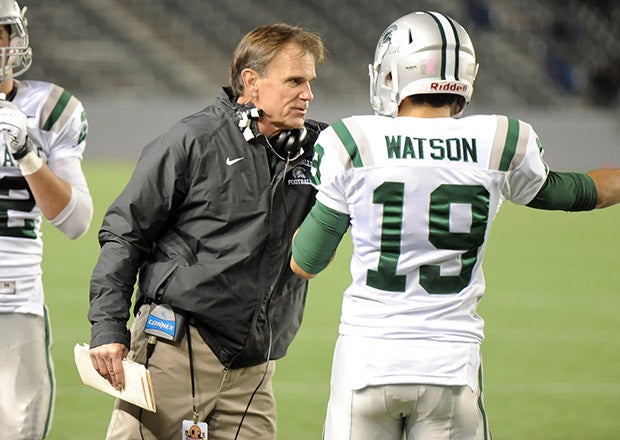
Pictured here in his last game on the sideline, a state championship win over Corona Centennial, Bob Ladouceur and his De La Salle Spartans built a 12-year win streak that captured the nation's attention. (PHOTO: Heston Quan)
Men like Knute Rockne and Paul Brown revolutionized coaching itself, introducing systems, preparation and organization that became the blueprint for modern football programs at every level.
At the very top sits a United States President
whose intervention at the dawn of the 20th century quite literally saved football by pushing safety reforms that allowed the game to survive and grow in American schools.
Together, these figures didn’t just influence high school football — they built the foundation that turned it into a structured, widely embraced and enduring part of American culture.
HSFB's top 25 most influential people
25. Henry Billings Brown
Judge in "Plessy vs. Ferguson"
Brown did not necessarily have a positive influence on high school football but he was an influence nonetheless. He wrote the majority opinion in the Plessy v. Ferguson Supreme Court case which argued that "separate but equal" did not violate constitutional rights. This ruling in 1896 led to the segregation of Blacks and whites in schools, particularly in the South, for nearly 75 years.
24. Phil Knight
Nike founder
Knight formed Nike in the early 1970s and the shoe company has gone on to become influential in supporting high school sports through apparel and uniform contracts, programs to increase participation in the sport and the improvement of player skills through summer individual and team camps.
23. Bob Ladouceur
De La Salle coach, winner of 151 straight games
As coach at
De La Salle (Concord, Calif.), Ladouceur established an aura of consistency and excellence with the Spartans by winning 151 straight games in the 1990s and 2000s. Ladouceur's team also popularized traveling to play the toughest opponents, including
Long Beach Poly (Calif.),
Mission Viejo (Calif.),
Mater Dei (Santa Ana, Calif.) and
Saint Louis (Honolulu, Hawaii).
22. Percy Haughton
Harvard football coach
As a coach at Harvard, Haughton influenced high school football coaching by becoming the first coach to have systematic practices and a disciplined approach to coaching. He developed hidden ball trick and lateral plays while emphasizing precise teamwork, laying the groundwork for modern coaching philosophy.
21. Bob Zuppke
Coach at Muskegon, Oak Park
Zuppke helped develop two high school dynasties, first at
Muskegon (Mich.) and later at
Oak Park-River Forest (Oak Park, Ill.) where he won three national championships. He coached at the University of Illinois with Red Grange as his star player. He developed the screen pass and the flea flicker and was also known for establishing the linebacker as a defensive position.
20. Andrew Pat Patterson
Prairie View Interscholastic League founder
Working with Prairie View A&M, Patterson led the way in providing a place for Black athletes to compete in high school sports at the same level as the UIL. The Prairie View Interscholastic League formed in 1940 and Patterson was one of the more successful coaches in the league.
19. Will C. Wood
CIF founder
The Commissioner of California Secondary Schools in 1914, Wood put forth the idea to create the California Interscholastic Federation in order to formally enforce faculty control of interscholastic athletics. His idea included four "sections" in the state — the Southern, Central, North Coast and Northern — which would allow for statewide competitions including the first state championships in football.
18. C.W. Whitten
NFHS executive secretary
In his 13 years as the executive secretary of the NFHS, Whitten was instrumental in formalizing the governmental processes for the federation and also for separating college institutions from participating in high school events.
17. Knute Rockne
Notre Dame football coach
In addition to being influential at the college level as the Notre Dame football coach in the 1920s, Rockne is known for creating pre-snap motion and stressing physical conditioning, aerobic conditioning and strategic rest periods.
16. Thurgood Marshall
NAACP lawyer in Brown vs. Board of Education
While Marshall did not directly influence high school football, he did influence desegregation in schools. Representing the NAACP, Marshall used previous court cases to take apart the "separate but equal" portion of the Plessy v. Ferguson Supreme Court ruling, eventually resulting in the Supreme Court outlawed segregation in schools.
15. Roy Bedichek
First Director of UIL
The longest-serving director of the UIL, Bedichek served from 1922 to 1948 and is considered to be the person most responsible for shaping the philosophy of the organization, according to the UIL website. He moved the UIL toward becoming influential in the improvement of the entire educational experience.
14. Grantland RiceVoice of sports golden age
Rice was an influential sports writer during the 1920s whose writing created almost mythic characters out of college and professional football players. He helped increase the popularity of the sport, which also led to high schools investing more money and resources on the sport at their level.
13. Art Johlfs
Compiled first national ratings
A former teacher in Minnesota, Johlfs established the first national high school football rankings in 1959 with his one-man organization called National Sports News Service. He did postseason rankings until his retirement in the late 1970s. He also gathered information and retroactively selected national championship teams back to 1927.
12. George Barclay
Invented football helmet
Generally credited with inventing the first leather helmet in 1896 to prevent cauliflower ear. Barclay, with the help of a harness maker, took three straps of leather to fit snugly around the head. Leather helmets did not go into widespread use, however, until the 1920s.
11. Jim Thorpe
Legendary multi-sport Native American
Along with Red Grange, Thorpe popularized the sport of football in the 1920s, first at Carlisle Indian Industrial School and later in the NFL. His ability also showcased the natural ability of Native American athletes.
10. Red Grange
Iconic star of early football
Grange's popularity at Wheaton High School, the University of Illinois and with the Chicago Bears in the NFL made the game of football hugely popular in the 1920s and became a model for high school athletes who wanted to play professional football.
9. Albert Spalding
Sports equipment, media mogul
After his Major League Baseball career came to an end in the late 1800s, Spalding went into the sporting goods business. As part of his catalog to sell sporting goods, Spalding also included rules to various sports, including football, and also printed season results, pictures and all-state teams for college and high school football. They were a crucial source for rules, scores and team previews from 1891 to the 1940s.
8. Doug Huff
Created first national record book
A sportswriter in West Virginia, Huff developed the first national high school football (and basketball) record book that was published in Letterman magazine and then by the National Federation of High Schools. Also spent decades doing national rankings and All-American football teams with Street & Sons Magazine and later Student Sports and ESPN.
7. Eddie Cochems
Developed the forward pass
After the forward pass became legal in 1906, Cochems devised a way to utilize it in his offense at St. Louis University. Rules at the time dissuaded the use of the forward pass, including a change of possession if a forward pass hit the ground. Touchdowns were also not allowed by forward pass. The ball was also blimplike, making it difficult to pass. While some teams attempted a pass or two a game, Cochems built his offense around it. His St. Louis team outscored opponents 417-11 in 1906. The rules of the game and the size of the ball eventually changed to allow for more passing.
6. Norwich Free Academy/Bulkeley High School
Played first football game
The first official high school football game occurred on May 12, 1875 between
Norwich Free Academy (Norwich, Conn.) and Bulkeley High School. According to Brian Girasoli, who wrote a book about the rivalry between the two schools, it is not known who organized the game. All other games descended from this first contest.
5. Paul Brown
Master strategist with unmatched preparation
In winning multiple state championships at
Washington (Massillon, Ohio), Brown had four teams named as national champions. He was the first to use classroom instruction to teach plays and he also used film to analyze his opponents and his own players. He was also responsible for putting together year-long coaching staffs.
4. Amos "Alonzo" Stagg
Foundational figure in American football
As a football coach at the University of Chicago from 1892 to 1932, Stagg was responsible for a number of innovations in the sport, including the huddle, a playbook with diagrams, the quick kick, the reverse, the man-in-motion and uniform numbers. He also was a big supporter of high school sports, hosting a national track meet and national basketball tournament during the 1910s and into the 1930s.
3. Pop Warner
Revolutionary mind behind modern play
As head coach at colleges such as Cornell, Georgia and Stanford, as well as the Carlisle Indian School with Jim Thorpe, Warner developed the Single Wing and Double Wing offenses and pioneered the three-point stance and the spiral punt and pass. A network of youth and junior football programs were established in his name.
2. Walter Camp
Father of American Football
Known as the "Father of American Football", Camp played football at Yale in the 1870s and was responsible for many of the innovations in the game that helped transform it from the sport of rugby to the game of football. Among those innovations included the creation of the "line of scrimmage" and the "system of downs". He also came up with the names of the positions of the players and determined that each side should play with 11 players.
1. Teddy Roosevelt
26th President of the United States
There would be no NFL, no college football and no high school football if not for our 26th president. With 19 deaths in college football in 1905, Roosevelt cautioned college leaders to clean up the sport or he would have it abolished. An avid sportsman, Roosevelt was a passionate fan of football because he felt it taught important life skills. A meeting between Roosevelt, officials and coaches led to the creation of an organization that eventually became the NCAA. He also emphasized the legalization of the forward pass and the creation of the neutral zone. Other reforms led to lessening the violence of the sport. Football stayed alive thanks to the changes instituted by Roosevelt and grew in popularity during the 1920s thanks to the efforts of coaches like Rockne, Warner and Zuppke and players like Thorpe and Grange.
