High school football isn’t shaped only by the people on the sidelines Friday nights — it’s built by innovators, storytellers and decision-makers whose influence reaches far beyond the scoreboard.
MaxPreps continues its countdown of the 100 most influential people in high school football history with Nos. 26-50. They represent the hidden architecture of the game — those who changed how athletes hydrate and recover with the creation of Gatorade, redefined where the game is played through the invention of Astroturf and gave the sport cultural meaning through authors like Buzz Bissinger, who showed the nation why high school football matters so deeply to American communities.
They also include state commissioners from powerhouse governing bodies such as the CIF and UIL, whose rules, championships and leadership shape opportunities for millions of athletes. There is also the Little Rock Nine, whose courage helped force integration into Southern schools and permanently changed who was allowed to play, cheer and belong. Together, these people didn’t just influence high school football — they reshaped its access, safety, storytelling and soul.
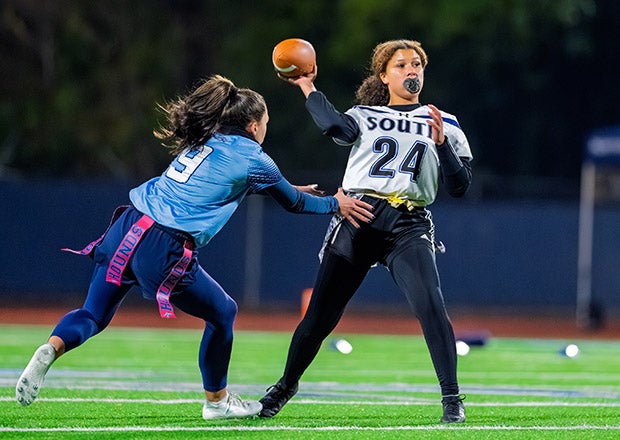
Fifty years after Patsy Mink helped enact Title IX, her work is still evident in the rise of girls flag football. (PHOTO: Luke Hamilton)
50. John "Red" Davis
Chose All-Southern Teams
No All-American teams existed for football until 1947, but John "Red" Davis selected the first regional all-star teams starting in 1919. As a reporter in Lake City, and later with the Orlando Sentinel, Davis selected the "All-Southern" team, which consisted of players from all of the states in the South from Florida to Texas and north to Kentucky. Davis chaired the committee for 25 years and the All-Southern teams were selected for 90 years.
49. Henry Luce
Sports Illustrated publisher
Luce is known best for launching Time magazine at the age of 25 in 1923. However, he makes the list for his other contribution to journalism — Sports Illustrated. First published in 1954, Sports Illustrated did not begin to include high school stories on its pages until the 1960s, but it has regularly done so ever since. It included high school athletes as part of its "Faces in the Crowd" feature. It also put a high school football player on its cover for the first time in 1974 when it featured Utah's all-around athlete Bruce Hardy. Luce was the editor-in-chief of the magazine from 1954 to 1964. While many of the magazine's articles about high school sports appeared in the magazine after Luce left the publication, it was Luce's vision that provided a platform for some of the best sports writing about high school sports.
48. Andy Beal
MaxPreps founder
As President of Waveshift, a Sacramento-area software maker, Beal made the bold decision in 2003 to use the recently acquired Sports Huddle software to cover high school sports. The original idea was to sell the software to newspapers, according to a story in The Sacramento Union in 2004, but when that didn't pan out, Beal decided to use the software himself to cover high school sports — first in California in 2003 and then across the country in 2004. MaxPreps has been the go-to source for high school sports rankings, statistics, rosters, scores and All-American teams for over two decades.
47. Rusty Russell
Developed spread offense
While coaching at the Masonic Home for Orphans in Texas in 1927, Russell came up with the spread offense because his team had many fast, but small, players and they were unable to match up with teams that had bigger players. The passing offense spread the field horizontally, giving Russell's faster players open room to run. His 1932 team went 11-0-1, tying Corsicana for the state championship. Known as the "Mighty Mites" in the film "12 Mighty Orphans."
46. Bill Schroeder
Founded Helms Foundation
A reporter with the Los Angeles Times in the 1930s, Schroeder became interested in starting a sports foundation for the preservation of sports history. With the help of philanthropist Paul Helms, an executive in the baking industry, Schroeder originated the Helms Foundation. Schroeder's contribution to high school sports came in the selection of all-star teams in the Southern Section and Los Angeles City Section for football and basketball starting in 1936. Both CIF sections continue to select all-section teams to this day. The Helms Foundation also inspired the formation of the Breitbard Foundation, according to Dan Fulop and his book "Bob Breitbard: San Diego's Sports Keeper," which celebrates high school sports in the San Diego Section through the selection of all-section teams and a Hall of Fame.
45. Bill McMurray
Texas journalist/record book publisher
His book "Texas High School Football" is considered the best of its kind on the subject and he also worked to produce the first Texas high school football record book in the early 1970s. He was named Greater Houston Area sports writer of the year 20 times in 27 years at the Houston Chronicle.
44. H.G. "Buzz" Bissinger
"Friday Night Lights" author
Known for his non-fiction book "Friday Night Lights", which chronicled a year at
Permian (Odessa, Texas), Bissinger's story showed the social aspect of the sport and how it affected the lives of the players and families. It also showed that the high school football team could be a microcosm of a town's identity.
43. Mose Simms
First All-American teams
A business man in Oklahoma, Simms promoted a summer high school all-star game featuring players from all over the country by selecting the first All-American team in 1947. Sponsored by the Wigwam Wisemen organization, the All-American teams featured six teams of 12 players each who were then eligible to play in the summer game. Simms continued the All-American teams and all-star game until his passing in the early 1960s.
42. Mark and Nelson Tennis
California record book, rankings
Mark Tennis, and his late uncle Nelson, have covered high school sports in California for over 50 years. In addition to providing state rankings and all-state teams for football (as well as many others sports) in the most populous state in the country, the two collaborated to produce the Cal-Hi Sports Record Book, possibly the most complete record book of its kind in the nation.
41. Haskell Cohen
Chose Parade All-American teams
In addition to originating the NBA All-Star Game in the 1950s, Cohen was responsible for selecting the Parade All-American teams, starting with basketball in the 1950s and adding football in 1963. He selected the teams every year up until 1997 and he passed away at the age of 86 in 2000.
40. Robert Cade
Developed Gatorade
Cade developed a fluid-replacement drink for University of Florida players after noticing that football players didn't have to urinate after games due to a loss of fluid. The drink became known as "Gatorade" and it has become a billion dollar industry that influences high school football through hydration science, player recognition awards and brand-level partnerships.
39. Davey O'Brien
Early influential quarterback
A graduate of
Wilson (Dallas, Texas) in 1935, O'Brien was one of the first players to star at the high school level as a passer. He went on to win the Heisman Trophy and played two seasons in the NFL. He quit the NFL to become an agent with the FBI. The Davey O'Brien Award annually honors the top quarterback in college football.
38. H.V. Porter
NFHS commissioner
Porter replaced C.W. Whitten as the director of the National Federation of State High School Associations and served from 1940-58. He was known as a "rules expert" and was responsible for writing many of the sport rule books for the NFHS. He lobbied for many years to join into a collaboration with the NCAA to forge a common rule book.
37. James Faria, Robert Wright
Developed Astroturf
While working for Monsanto in the early 1960s, Faria and Wright developed the first artificial turf. The first test of the product, known as "Chemgrass" was installed at
Moses Brown (Providence, R.I.) in 1964. Later, the turf was installed at the Houston Astrodome and became known as "AstroTurf." The invention has gone through some innovations, going from a short-pile to a longer pile with infill that is popular today.
36. Seth Van Patten
Southern Section commissioner
Influential as the director of the Southern Section track meet for 39 years, Van Patten became the section's first official commissioner in 1930, a position he held for 20 years. He was known as the "Father of the CIF (Southern Section)" and helped change football from a participant sport to a spectator sport.
35. Rodney Kidd
Director of UIL
Kidd spent two decades (1948-68) as the director of the UIL and was responsible for the desegregation of high school sports in the state when it combined with the Prairie View Interscholastic League.
34. John Riddell
Developed cleats, plastic helmets
A high school football coach at
Evanston (Ill.), Riddell developed the first football cleats with removable spikes to adjust for different types of field conditions. He eventually quit his coaching job to sell athletic equipment. His company invented the first plastic helmet in 1939 as well as the web-sling portion that provides a pocket of air between the head and the helmet.
33. Herman Masin
"Scholastic Coach" publisher
The longest-tenured editor of any magazine in United States history, Masin oversaw the production of Scholastic Coach magazine for 72 years, starting in 1936 until his retirement in 2008. He died in 2010 at the age of 96. Scholastic Coach was dedicated to teaching fundamentals of sports along with safety and teamwork. The magazine also produced articles by coaches, highlighting their best plays along with their game and practice strategies. Scholastic Coach picked a football, basketball and track and field All-America team starting in the early 1950s and lasting for nearly 40 years.
32. Dave Krider
Compiled USA Today rankings
A Hall of Fame journalist from La Porte, Ind., Krider started the first weekly high school football rankings during his time with USA Today. He spent several decades selecting USA Today's All-American teams and later was a contributor for MaxPreps.
31. Edward. E. Litkenhous
Developed national computer rankings
A Vanderbilt professor, Litkenhous and his brother Francis developed a "difference by scores" rating system that was used to determine high school football and basketball rankings from 1938 to 2018. The Litkenhous rankings are also used by the NCAA to determine national champions in football from 1934 to 1984. The Litkenhous rankings were used on a regular basis in Kentucky, Tennessee, Indiana and Minnesota.
30. Patsy Mink
Principal author of Title IX
Mink worked for sports inclusion during the vote on Title IX in 1972. Title IX prohibits gender discrimination in education and Mink made sure that sports were included as part of this decision, with the hope of increasing female participation. Originally, it was feared that Title IX might lead to the elimination of high school football from sports programs. Instead, the sport has increased in popularity among males. Meanwhile, Title IX has also provided schools the opportunity to field flag football teams for girls.
29. Dave Campbell
Texas Football Magazine creator
Called the "George Washington" of Texas sportswriters by Kevin Sherrington of the Dallas Morning News, Campbell began publishing his bi-annual magazine in 1960, showcasing over 1,500 football teams in Texas. Campbell's Texas Football was the go-to source for information on high school football.
28. Clark Shaughnessy
Created T-formation
While at Stanford in 1940, Shaughnessy developed the T-formation, which put the quarterback under center instead of lined up in the backfield as part of the single wing. The formation became difficult to defend because it allowed for play-action passes and deception along with putting players in motion to spread the defense. The offense became a standard for high schools due to its flexibility.
27. E.W. Oliver
First CIF director
The first director of the California Interscholastic Federation, Oliver was crucial in carrying forth Will C. Wood's vision of "faculty control of interscholastic athletics." He had a broad-minded view of athletics, moving away from the stricter rules of amateur sports at the time. Oliver was also essential in developing the CIF into a statewide agency.
26. Little Rock Nine
High school desegregation
The
first nine Black students who integrated
Central (Little Rock, Ark.) were Minnijean Brown, Terrance Roberts, Elizabeth Eckford, Ernest
Green, Thelma Mothershed, Melba Patillo, Gloria Ray, Jefferson Thomas and Carlotta Walls. Central had the top football team in the
country in 1957. While the Little Rock Nine did not directly influence
the football program, the high-profile event, which prompted President
Dwight Eisenhower to call in the National Guard to enforce, influenced
the desegregation of schools across the country and led to Black players
playing along white players all across the South.
Up next: The top 25 includes a legendary Notre Dame coach, the world's greatest athlete and a United States President.
